What are the Fire Safety Regulations In England?
You live or work in a shared or commercial building in England, and are concerned about the safety from fire. There is no need to worry because the Fire Safety Regulations UK set clear rules to protect everyone from fire risks. These regulations make building owners and managers accountable for fire assessments, alarms, and emergency routes.
You can also get guidance from the Property Management Company, which can help your building to meet all fire safety requirements.
Which Buildings Are Covered By The Fire Safety Regulations?
Different types of buildings have specific rules for the protection from fire hazards, which are explained below in detail:
Multi-Occupied Residential Buildings
In these buildings, many people live under the same roof, such as in shared housing, flats, or apartments. These buildings require extra safety because residents share the corridors, stairwalls, and lifts. It is the responsibility of the landlords and managers of this type of residential houses to secure the safety by installing tools such as fire alarms, fire doors, and signage, etc.
Buildings Over 11 Metres in Height
The building blocks that are bigger than 11 meters need specialised protection from fire hazards. Because it’s difficult to manage or control the fire in these premises. These buildings must have fire safety measures, including stricter alarms, fire doors, and evacuation plans.
The responsible persons must provide safety information to residents and maintain all fire safety equipment to protect residents and occupants. He should also carry out annual checks on flat entrance fire doors.
High-Rise Residential Buildings
Residential buildings that are more than 18 meters are called high-rise buildings. These require additional safety checks than other buildings, such as
- Secure Information Boxes
- External Wall Systems
- Building Plans
- Lifts and Other Key Fire-Fighting Equipment
- Wayfinding Signage
What Are the Phases of Fire Safety Reforms in England?
Here are three key phases of fire safety reform in England that have updated the 2005 Fire Safety Order (FSO)
| Phase | Regulation | Purpose |
| Phase 1 | Fire Safety Act 2021 | It clearly says who is responsible for fire safety in shared areas of buildings. |
| Phase 2 | Fire Safety (England) Regulations 2022 | It adds extra fire safety duties for taller residential buildings in England only. |
| Phase 3 | Building Safety Act 2022 (Section 156 changes) | It updates and strengthens the existing fire safety rules for all buildings covered by the fire safety law. |
| Phase 4 | Fire Safety (Residential Evacuation Plans) (England) Regulations 2025 | Introduced mandatory Personal Emergency Evacuation Plans (PEEPs) for vulnerable residents and Building Emergency Evacuation Plans (BEEPs) for high-rise and risky residential buildings, that is effective from 6 April 2026. |

What Do the Regulations Require Responsible Persons To Do?
The responsible person for fire safety in business or other non-domestic premises can be an employer, the owner, the landlord, an occupier, or anyone else with control of the premises. For example, a facilities manager, building manager, managing agent, or risk assessor.
The key responsibilities of the RPs are given below
- Regularly review fire risk assessments.
- Communicate identified risks to staff and representatives.
- Establish and maintain fire safety measures.
- Prepare emergency evacuation procedures.
- Deliver fire safety training and information to staff.
What Are The Essential Fire Safety Equipment?
Some of the important fire safety equipment that helps to minimise the fire risk is explained below:
Fire Detection and Alarm Systems
Fire alarm systems are installed in buildings to protect property and life. Systems must comply with BS 5839-1 for non-domestic premises or BS 5839-6 for domestic premises.
| The BS 476 fire testing standard is being phased out from March 2025, replaced by the European standard BS EN 13501. All building materials and systems must now meet this new classification. BS 476 will be fully withdrawn by September 2029 |
Fire Extinguishers and Fighting Equipment
This equipment is essential for controlling small fires and keeping everyone safe in a building. The common equipment includes water extinguishers, CO₂ extinguishers, and fire blankets, all of which should be positioned in easily accessible locations near exit areas. From 2 March 2025, sprinkler systems will be a mandatory legal requirement in all new care homes, regardless of building height or size.
| Note: AFFF (Aqueous Film-Forming Foam) extinguishers are banned as of 4 July 2025 due to harmful PFAS chemicals. Replace them with compliant, eco-friendly alternatives. |
Emergency Lighting
These lights are used in emergencies to guide occupants to escape a building during power failures or fires. It includes exit signs, corridor lights, and stairwell illumination that are used in evacuation routes to make them visible even in smoke or darkness.
Fire Doors
These are specially designed doors that resist fire and smoke. They should be installed in stairwells, corridors, between flats, and at entrances of high-risk areas.
Signage and Wayfinding
These are significant for helping occupants and emergency responders make a building safe during a fire or power outage. This includes exit signs, directional arrows, floor maps, and stairwell indicators, which must be clearly visible and well-lit at all times.
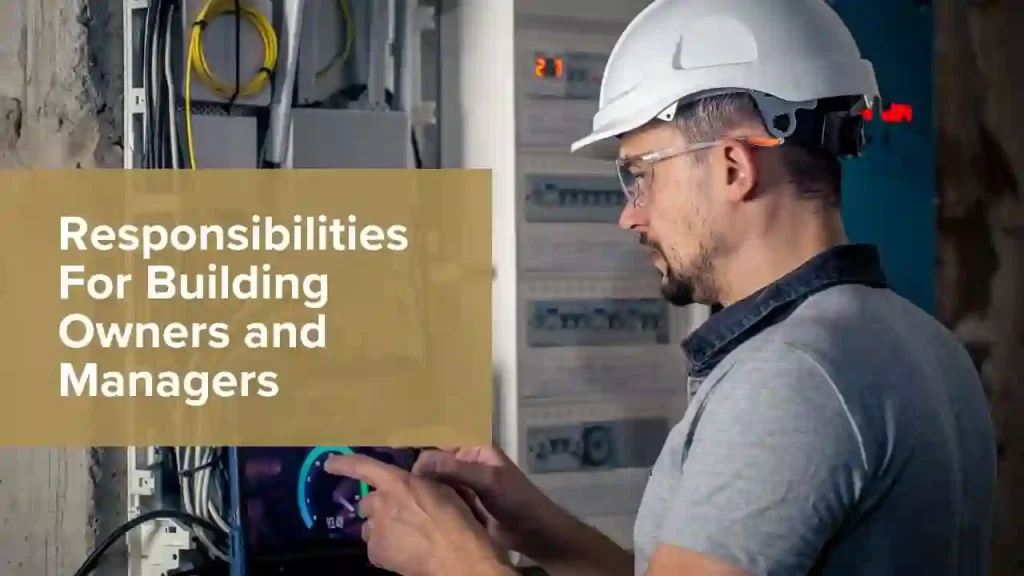
Responsibilities For Building Owners and Managers
- They should conduct regular assessments of the risk to find any problems in the building.
- Its major responsibility of the building owners to install the smoke detectors, alarms and automatic fire detection systems.
- Check this equipment regularly to see if they are working normally or not.
- Fire doors should be fitted in stairwells, corridors, and flat entrances.
- Keep all corridors, stairwells, and exit paths clear of obstructions for safe evacuation.
- They should maintain exit signs, emergency lighting, and floor maps for proper wayfinding.
- They should also share building plans and details of external walls with local fire and rescue services.
- Managers must train staff and residents on evacuation procedures, alarm responses, and safe use of fire equipment.
Who is Affected By The Fire Safety Regulations?
Responsible persons, building owners, and managers of non-domestic and multi-occupied residential buildings are affected by the Fire Safety Regulations. The reason is simple, that there are stricter rules for high-rise buildings. That’s why the rules focus on careful safety checks, sharing clear details with fire services, and simple steps that help people feel protected during emergencies.
Conclusion
Fire safety regulations in the UK have been upgraded over time for the protection of citizens in high-rise and multi-occupied buildings. By following the rules, responsibilities and usage of proper equipment, the incidents of fire can be decreased. It is because if we follow the regulations for fire safety, it not only prevents us from a major accident but also gives us peace of mind.